

The Persian Carpet at Kensington: How Kashmiri Craftsmen Wove Themselves Into India's Diplomatic History
Ashwin Dhanabalan in conversation with Amb. Latha Reddy
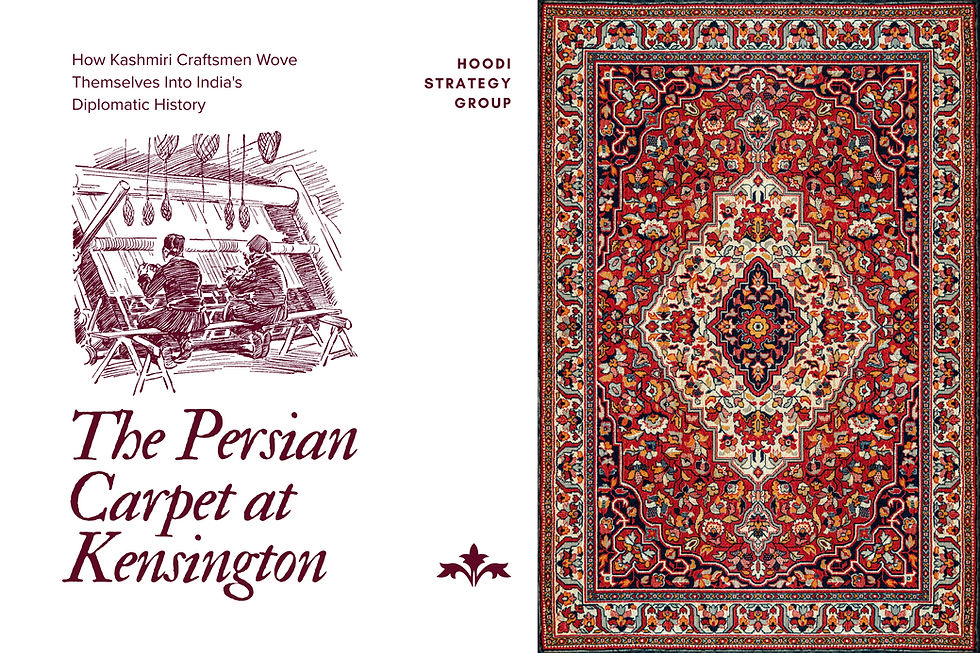
At 9 Kensington Palace Gardens, London, there is a dining table that seats twenty-four. Heads of state have sat at it, Prime Ministers have made small talk across its length, and trade deals have been gestured at over its surface. By any standard, it ranks among the most consequential pieces of furniture in Indian diplomatic life. Beneath it lies a Persian carpet.
Most guests who have dined at the High Commissioner's residence in London likely never noticed the carpet. Absorbed by conversation, occasion, and the choreography of high diplomacy, they overlooked it. Yet, that carpet carries a story that, in its quiet way, is as instructive about how India conducts itself in the world as any treaty or communiqué.
Over the years, the carpet became damaged and torn, with dining chair castors repeatedly catching and pulling at its fibers during formal dinners. According to the Ministry of External Affairs’ Annual Report for 1999–2000, the Establishment Division allocated funds for construction and renovation of properties abroad during Ambassador Latha Reddy’s tenure. This extensive work included the renovation of the Kensington residence around 2000–2001 replacing carpets, installing new furnishings, and undertaking tasks that might have gone unnoticed. Instead, the carpet was sent to Srinagar for restoration.
A crucial facilitator in this endeavor was Afzal Abdullah, a trusted family friend of Ambassador Reddy, who coordinated the restoration through Asia Crafts, a specialist carpet house in Srinagar. This personal connection rarely captured by official procurement channels ensured the right craftsmen were found for the task. Abdullah's role highlights a broader truth about diplomatic renovations: institutional processes must be complemented by personal networks that can identify, verify, and vouch for exceptional artisanal skill.
Equally indispensable was Ms. Gaitri Issar Kumar, IFS, a career diplomat who worked closely with Ambassador Reddy, coordinating with the Ministry of External Affairs in New Delhi and navigating the complex administrative processes required for diplomatic property renovations abroad. Her meticulous approach extended well beyond the Kensington project, shaping renovation efforts for Indian government properties worldwide. Remarkably, Ms. Kumar later served as High Commissioner of India to the United Kingdom from June 2020 to June 2022, returning to the very residence whose transformation she had helped guide two decades earlier.
The Craft Behind the Restoration
Kashmir's carpet weavers have been at their looms since the fifteenth century. The tradition arrived with Persian craftsmen invited by Sultan Zain-ul-Abidin, whose reign over the valley is remembered as a cultural renaissance. By the time the Mughals consolidated their hold on the subcontinent, Kashmiri carpets had already found their way into the imperial courts at Agra and Delhi.
The craft is built on the talim, a coded notation system, almost like a musical score, that records the exact placement of every knot, every colour, row by row and is learned over years, passed within families, whispered from master to apprentice. What makes a Kashmiri carpet exceptional is precisely what made it the right choice for that damaged Persian carpet in London: the ability of the weaver to enter an existing pattern, to read its logic, to weave new threads into old structure so seamlessly that the repair becomes invisible.
The carpet was restored in Srinagar, its torn sections expertly rewoven to match the original, and then returned to London, where it was reinstalled beneath the same table this time protected, whole, and ready for decades more of state dinners. There was no press release, no diplomatic cable to commemorate the event. The weavers of Srinagar do not appear on the guest lists of the dinners that have since been held in that room.
This is the invisible labour of diplomacy. When we speak of soft power, we reach instinctively for the visible: cultural festivals, film exports, yoga diplomacy, cuisine. We speak of what India presents to the world. What we speak of less often is what India preserves the meticulous, largely anonymous custodial work that keeps the physical fabric of the nation's diplomatic presence intact, dignified, and worthy of the occasions it hosts.
The Kensington Renovation
The Kensington renovation was not a small undertaking. The High Commissioner's residence, a Crown Estate property whose freehold has always belonged to the Crown, and whose exterior restoration required negotiation with Crown Property authorities, had to be gutted and rebuilt from the inside while the exterior scaffolding went up. The bones of the building were good: 18th-century French wall panelling, original to the residence, had survived decades of diplomatic life. But the building leaked, the interiors were worn, and the whole thing needed to be done without losing what was worth keeping.
Ambassador Reddy’s approach was both practical and distinctly Indian. She enlisted an architect she recalls a man named Pramod who designed the interiors to complement the original panelling. Indian tailors and upholsterers were sourced, granted British work permits, and brought to London to reupholster every piece of furniture on-site. Curtains were remade, carpets restored, and when the work was complete, the residence was, in Reddy’s words, “beautiful, beautiful” a space that honored its heritage while becoming truly functional for diplomatic life.
The total cost to the Indian taxpayer was only a fraction of what full replacement and refurbishment would have required. The cultural dividend, however, was immeasurable. These outcomes were made possible by two key individuals: Afzal Abdullah, who ensured the carpet reached the skilled artisans at Asia Crafts in Srinagar, and Ms. Gaitri Issar Kumar, IFS, who navigated the institutional approvals and inter-agency coordination necessary for projects involving India’s sovereign properties abroad.
Soft Power as Institutional Character
Discussions of Indian foreign policy often frame soft power as a deliberate strategy a communication exercise or a “Brand India” campaign. Yet the Kensington renovation reveals something deeper: soft power as institutional character. Choosing to restore instead of replace, to bring Indian craftsmen to London rather than hire locally, to have a Kashmiri weaver repair a Persian carpet for an Indian diplomatic table none of these were calculated soft power moves. They were acts of good judgment by diplomats who understood that the dignity of the spaces where India conducts its foreign relations is itself an expression of statecraft.
This is the JS Establishment’s quiet legacy. Today, managing India’s global diplomatic estate falls to the Global Estate Management (GEM) Division within the MEA. Tenders are issued, contractors selected, surveys commissioned. Yet the underlying philosophy remains: India’s diplomatic residences are not mere offices, but repositories of cultural continuity places where craftsmanship speaks volumes before a single word is uttered. That philosophy is sustained, or lost, in the details: in the decision to repair a damaged carpet; in ensuring the repair is entrusted to those whose skill and tradition make it right.
Ambassador Reddy recalled the satisfaction she felt when the renovation was complete. It is the quiet satisfaction of someone who knows that the work will outlast the posting that the next High Commissioner, and the one after, will sit in rooms that were made with care, that the twenty-four-seat table will still have a carpet beneath it, and that somewhere in Srinagar, the weavers who made it whole again have no idea that their knots are holding up the diplomatic life of a nation. That is not a failure of recognition. It is, in fact, the definition of the work.
Soft power, at its most durable, does not announce itself. It is woven in.
Ambassador Latha Reddy is a Founding Partner at the Hoodi Strategy Group. She was also the former Deputy National Security Advisor of India & Secretary (East) at the Ministry of External Affairs. Ashwin Dhanabalan is a Research Associate at the Hoodi Strategy Group & Konrad Adenauer Stiftung (KAS) Doctoral Scholar at Christ University, Bengaluru, India.
120 Cunningham Road, 2nd floor, Bengaluru, Karnataka 560052